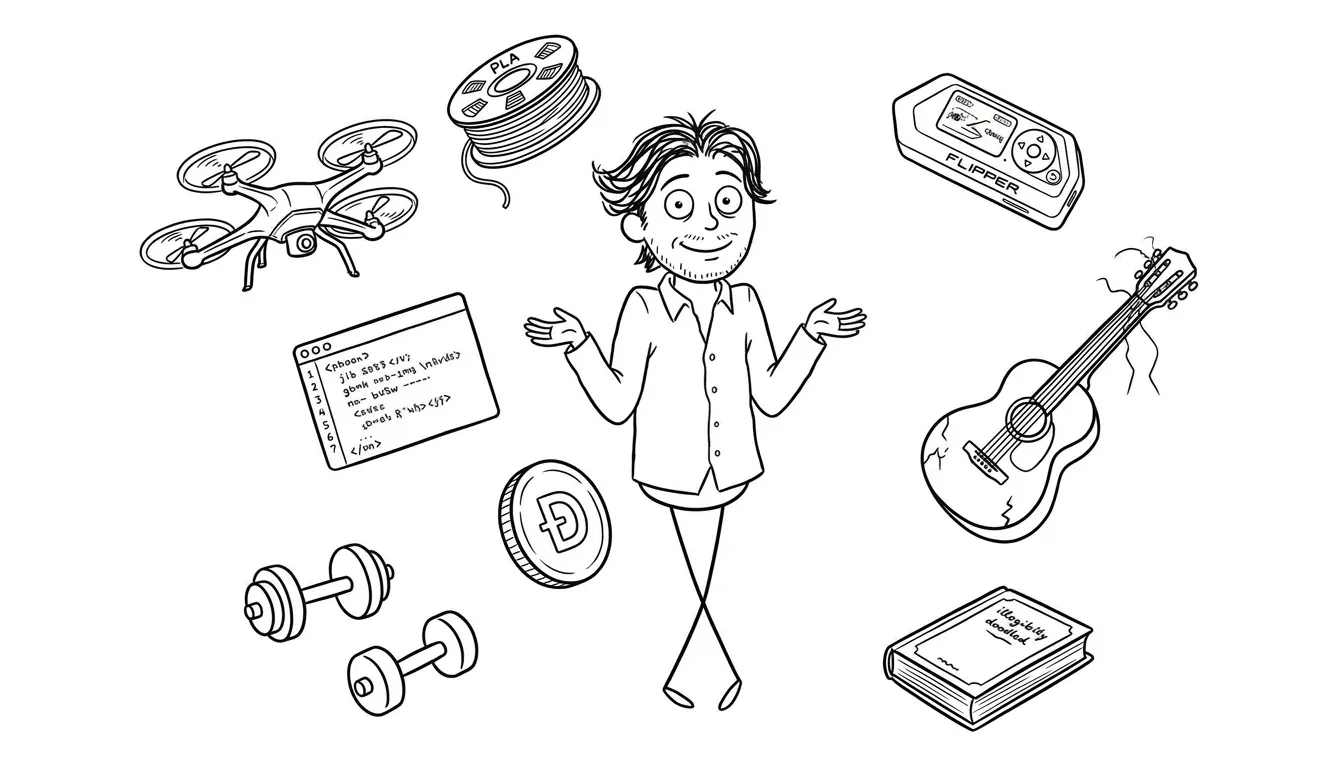
Seventeen years. That’s how long ADHD has been making me touch every skill, hobby, and career path that crossed my path. I’m 30 now. I’ve lived in eight countries, built products in five programming languages, shipped code on four blockchains, released music on Spotify under an artist name I genuinely cannot remember, and learned enough Vietnamese to haggle at a market in Nha Trang.
A lot of it stayed at the level of useful. A few things became real expertise.
That’s the honest version of this story. Not the LinkedIn version where “my diverse background gives me a unique perspective.” The real version, where I’ve spent a decade and a half chasing dopamine across every domain imaginable and I’m only now figuring out what that actually means for a career, an identity, and a life.
What the ADHD cycle actually looks like across every skill, hobby, and career path
The cycle runs on roughly a two-week clock. Something new appears - on Twitter, in a YouTube rabbit hole, in a Discord I shouldn’t be in at 2am. The dopamine hits immediately, before I’ve done anything. I’m already planning the next phase while I’m still in the first hour.
Then comes the manic stretch. Twelve-hour sessions at the computer, deep in documentation and GitHub repos and forum threads from 2015 that nobody else has read. I still eat well, still sleep well, still train. Health is the one thing I never let slide, no matter how deep the rabbit hole goes. But everything else disappears.
Two weeks later, sometimes less, I wake up and it’s gone. Not burnout. Burnout has texture - exhaustion, resentment, a desire to rest and come back. This is nothing. Flat affect toward something that consumed me completely three days ago. The interest didn’t fade. It evaporated.
This has been my entire adult life. Before that, too - graffiti, parkour, long-distance running, acrobatics, all before I owned a computer. I fixed a relative’s MS-DOS machine in English when I was around eight and barely spoke English. I rigged our home phone line to connect to a friend’s LAN across the city. I built a radio to intercept our wireless home phone so I could eavesdrop on my mom’s calls.
I was never bored. I was always building something I’d abandon.
What I didn’t understand at eight, and only started to understand around 27, is that this isn’t a moral failing. It’s the shape of how my brain processes novelty. The dopamine system in ADHD brains responds to new stimuli harder and drops off faster than neurotypical brains. I wasn’t undisciplined. I was running a biological process I had no name for.
Knowing that doesn’t stop the cycle. But it changes how you relate to the wreckage.
The graveyard is real
Let me just list some of it.
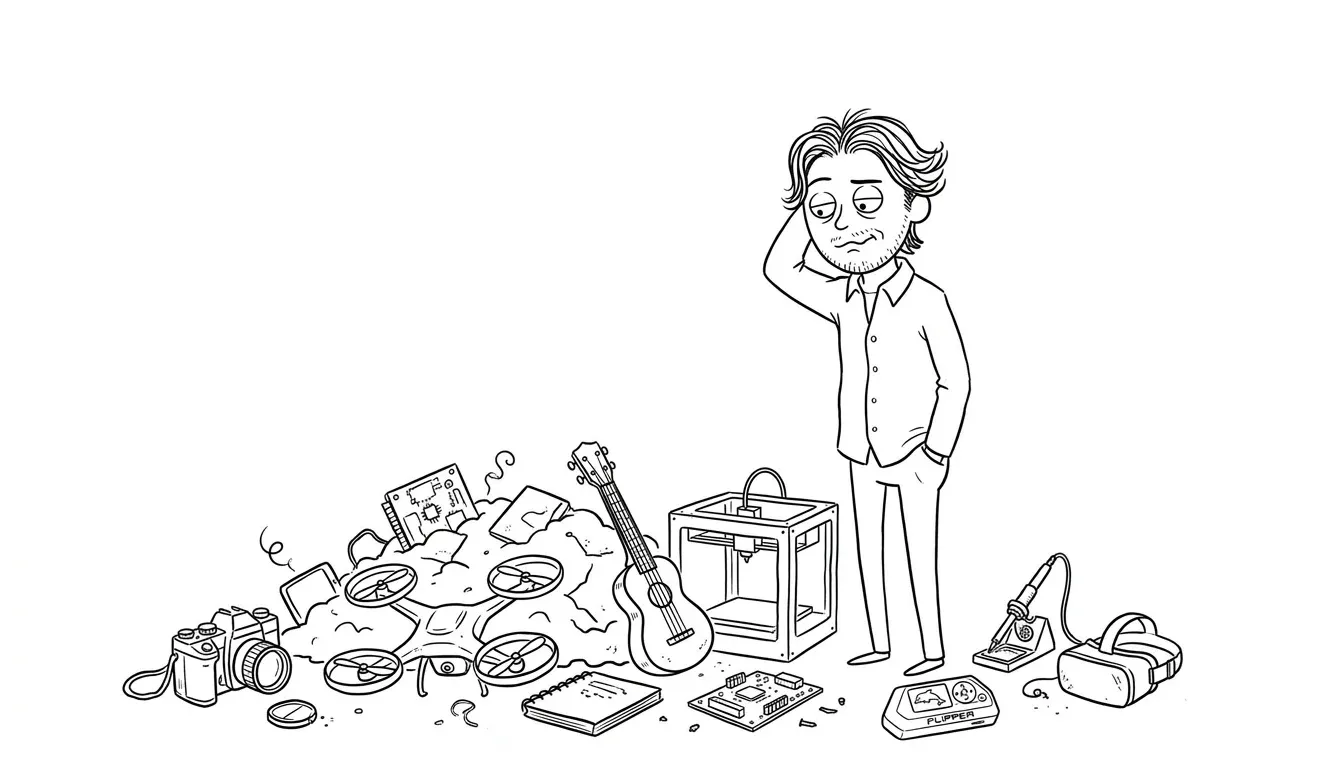
A DJI drone I used four times. A Sony DSLR that mostly lives in a bag. A 3D printer I operated twice, let collect dust for six months, and sold at a loss. A soldering station I learned to use at university, felt was essential to own again years later, and which currently sits in my wardrobe untouched. A ukulele from Turkey. Guitar - I can play a few songs. Piano - I can play Kanye’s Runaway and that’s it. Harmonica. Stylophone. Otamatone. An AKAI MPK Mini. Ableton. AI music with Suno. I released lofi tracks on Spotify. I cannot remember the artist name.
Stocks in Russia via an app. Mostly broke even, maybe lost a bit. Cybersecurity hardware - a Flipper Zero, a Kali Linux laptop, ESP32 boards with Marauder firmware, an ESB dongle for intercepting TPMS sensors, and an M5Stack kit with a pile of controllers and sensors. Cardputer. LLM630. Tiny screens, weird modules, more little boards than I had any reason to own. I spent weeks flashing firmware and scanning radio frequencies. Did I build anything useful? No. Make money? No. But I understood how your wireless water meter broadcasts unencrypted data to anyone with the right hardware, and that felt worth it.
None of this is sustainable. The “ADHD is a superpower” content you see everywhere stops before this part. The graveyard. The money spent. The projects half-finished. The domains where I got to “good enough to be dangerous” and never further, because the dopamine was already somewhere else.
This pattern has been running long enough that it stopped feeling surprising a while ago.
The financial reality nobody mentions
I want to be concrete about this because most “ADHD and creativity” content is vague about costs.
The 3D printer was around $400. Sold for $180. The drone was $700. Used it maybe ten hours total. The cybersecurity hardware - Flipper, M5Stack, the various ESP32 boards, cables, accessories, random modules - probably $600 spread across three months. The Ableton license. The AKAI. The ukulele I bought in a market in Istanbul because I was in a hyperfocus phase about lo-fi music production.
I don’t have an exact number. But it’s real money. And this doesn’t count the opportunity cost of the hours - hundreds of hours flashing firmware on microcontrollers that never produced anything, learning guitar in 30-minute sessions spread across five years, studying Vietnamese for six weeks before the next interest hit.
I’m not saying this to make it sound worse than it is. I’m saying it because the “embrace your ADHD divergent thinking” content leaves this part out and I think it’s dishonest. The breadth has real costs. The search has a price.
When it does stick
Some things stuck. Design, 17 years. The gym, 15+ years. AI, three years and accelerating.
I started freelancing at 14, selling forum banners and GIFs on ICQ. By university I was building websites for roughly $80-120 each in local-currency terms at the time. When I graduated, companies were offering something like $150 a month. I was already making more than that per site. I said no thanks and kept going. Design is probably the closest thing I have to real expertise after 17 years - I spent five of those years as the solo senior product designer at VALK, a fintech platform that moved $4B+ in deals across 70+ financial institutions in 15 countries. Awards. Real scale. Products that live in actual banks.
The gym stuck because I started before I knew what consistency meant and just never stopped. Different approaches over the years - bodybuilding, strength, cuts, boxing for two years in Krasnodar - but the baseline never dropped. I track bloodwork every few months and stay on top of health like it’s another system to tune. When something becomes infrastructure instead of a project, the ADHD can’t kill it.
AI stuck because it’s the first domain that feeds the obsession cycle faster than the cycle drains it. Every week there’s something genuinely new. You can’t get bored because the field won’t hold still. I built one of the first agentic loops I’d seen anyone build in 2022 - a Telegram bot for a crypto community that could reason and take actions, before “agentic” was even a term. I didn’t know what I was building. I just thought it was interesting.
Now I let AI maintain my second brain - knowledge, reminders, loose thoughts, follow-ups, personal assistant type shit. Less “look at my agent stack,” more “I built something that remembers what I forget and keeps my life from scattering.” I also host local models on a Mac Mini because of course that became another obsession too - if something can run on my own box, I want to try it. It’s not a demo. It runs every day. You can read more about how I approach coding and multi-model workflows if you want the technical side.
Why some things survive the cycle
I’ve thought about this a lot. What makes design and the gym persist when everything else evaporates?
Two patterns show up every time.
First: external feedback loops that don’t require internal motivation. The gym gives me bloodwork numbers, strength PRs, photos over time. Design gives me client feedback, shipped products, metrics. When my internal interest flags, there’s still external data pulling me back. The drone had none of that. The guitar had none of that. They only worked when I was actively excited, and when the excitement went, nothing remained.
Second: the domain kept changing fast enough to feed new obsession cycles. Design went from print to web to mobile to design systems to AI-generated UI. Every three years there was a new layer to get obsessed about. The gym went from machines to compound lifts to programming to bloodwork optimization. The domain regenerated novelty before I burned through it.
AI has both properties at a ridiculous level. New model every month. New architectural pattern every six weeks. New tool category every quarter. It’s basically a purpose-built trap for an ADHD brain and I walked straight into it.
How ADHD shapes every skill, hobby, and career path you choose
Here’s what I’ve realized after 30 years of this: ADHD doesn’t just affect how you learn things. It determines what career paths even become available to you.
I have an Information Security bachelor’s that I haven’t used professionally once. But the two years I spent in that program gave me networking fundamentals, an understanding of cryptography primitives, and enough systems-level thinking that when blockchain showed up in my life it wasn’t foreign territory. That “useless” degree became the reason I could evaluate Solidity code for security issues at VALK without being a dedicated security engineer.
The career I’ve actually had - designer, then product lead, then AI engineer - looks like three different careers. But they’re the same brain solving the same problem at different layers of abstraction. Design is about modeling user mental states. Product is about modeling system interactions. AI engineering is about modeling agent behavior. I didn’t pivot three times. I drilled down.
That’s the ADHD career path nobody maps: not a straight line, not even a zigzag, but a spiral. You come back around to the same core problems from different angles. The angle changes. The problem doesn’t.
The generalist discount problem
No job posting says “wanted, someone who can do a little bit of everything.”
Generalists get discounted by hiring processes designed for specialists. I have production code in TypeScript, Python, Rust, Solidity, and SQL. Deployed products on four blockchains. Sysadmin experience across every OS since childhood. Enough crypto experience to have launched 20+ tokens. On a resume this looks scattered. In a specific situation - say, a 48-hour sprint where a client needs a smart contract, a minting frontend, and custom illustrations - it’s exactly what’s needed and nobody else in the room has all three.
When VALK wanted a Christmas NFT campaign I told them I’d handle it. Smart contract, minting site, illustrations, the whole frontend - solo, in one sprint. That’s not something a specialist does. That’s an ADHD brain that collected 12 different surface-level skills over a decade, all converging on one afternoon’s work.
The problem is you can’t interview for that. “I know a little about a lot” doesn’t clear an ATS. So the career path for someone like me had to go around traditional hiring - freelance, founding roles, solo building. Places where the breadth shows up in delivered work rather than credentials.
The breadth problem and the breadth premium
This year I wrote a 33,000-word book from scratch. I’d never written a book before. Don’t Replace Me: A Survival Guide to the AI Apocalypse - 24 chapters, formatted, cover designed, published on KDP, audiobook via ElevenLabs, SEO landing page with schema markup, Amazon ads. Not because I wanted to be an author. Because the process of building the whole machine was interesting to me.
The ADHD didn’t stop me from finishing a book. It kept me engaged long enough to finish one because there were 15 different new processes to learn inside the single project. The writing was interesting for the first 10,000 words. Then the Kindle formatting was interesting. Then the audiobook pipeline. Then the schema markup. By the time I finished, I had a complete book, a production process, and had learned four skills I didn’t have before.
This is the pattern. I don’t go deep on one thing. I go wide enough that when a project needs five different skills, I’m the one person in the room who can cover them all. The breadth is a premium in those moments - genuine leverage that a specialist can’t replicate without a team.
The honest version though: those moments don’t come every day. Most days, the breadth just means I know enough to be frustrated by problems in domains where I don’t know enough to solve them.
Why the AI age changes this calculation for ADHD builders
AI is doing something weird to the generalist problem. On one side, everyone’s a generalist now. Vibe coding means your non-technical friend can ship a landing page. The moat of “I know five programming languages” is basically gone.
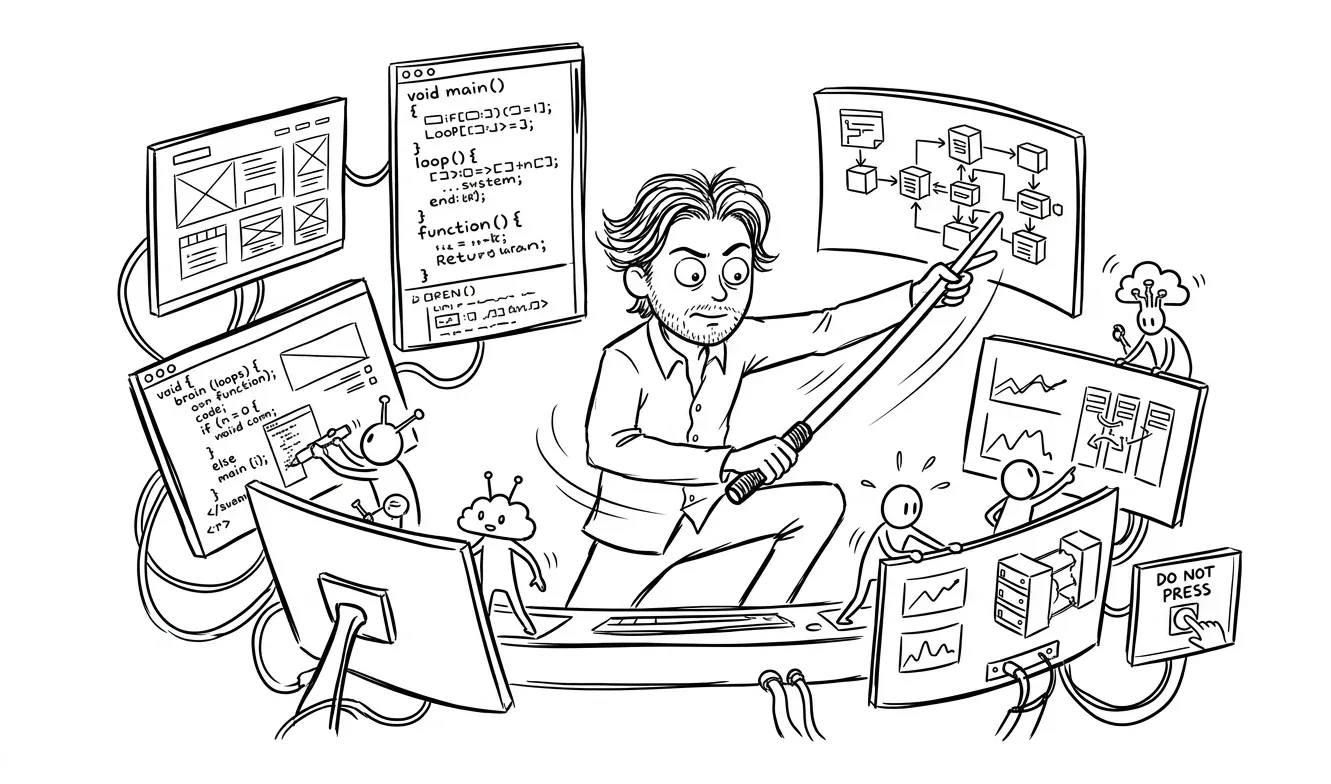
On the other side - and this is the part I actually believe - breadth becomes more valuable when AI amplifies execution. You don’t need to be an expert Rust developer. You need enough Rust to direct an AI agent doing Rust work. You need to know when the output is wrong. You need the taste to recognize what “good” looks like without being able to produce it from scratch at 100 words per minute.
I spent 17 years accumulating surface-level knowledge across maybe 30 domains. That knowledge doesn’t help me compete with a specialist in any one of them. But it means I can look at an AI’s output in almost any domain and tell you whether it’s right. Design intuition applied to code review. Crypto chaos tolerance applied to agentic system failures. Sysadmin muscle memory applied to Docker containers. The ADHD brain that couldn’t go deep now has a use case that rewards breadth.
This isn’t hypothetical. I use dee.ink - a collection of 31 Rust CLI tools I’ve built for AI agent workflows - as a practical example. Building those tools required Rust, CLI design, documentation, packaging, and enough understanding of AI agent needs to spec useful primitives. Same with the home lab stuff - a ZimaBoard running home server experiments, local infra, and smart home services because once I touched self-hosting I obviously had to touch that too. A specialist Rust engineer would write better Rust. A specialist AI engineer would understand agent needs more deeply. A specialist infra person would build a cleaner home lab. But I could build the whole thing myself, end to end, without waiting on anyone.
That’s the AI-era argument for the ADHD generalist: you’re not competing on depth anymore. You’re competing on range of judgment. And AI is making range of judgment the bottleneck, not depth of execution.
If you’ve felt this same tension - the generalist guilt, the half-finished projects, the identity question of what you even “are” professionally - I wrote more about navigating ADHD and AI as actual compensation tools, not the productivity-porn version.
The identity question ADHD every skill, hobby, and career path creates
Here’s the thing nobody talks about with the ADHD generalist lifestyle: you don’t know what you are.
Ask a specialist what they do and they tell you in one sentence. “I’m a backend engineer.” “I’m a product designer.” The identity is clean. The work is legible to other people.
Ask me and I have to make a choice about which version of myself I’m presenting. The designer with 17 years? The AI engineer building multi-agent systems? The guy who spent three months obsessively learning about RF signal interception for no professional reason? All of these are equally true. None of them is the whole answer.
For a long time this felt like a problem. I’d look at people with clear professional identities - engineers who’d been doing one thing for ten years, designers with a coherent portfolio narrative - and feel like I was faking it. Like my breadth was evidence of some underlying lack of commitment.
What I’ve landed on at 30 is different. The identity question isn’t a problem to solve. It’s a feature of a specific type of brain operating at full capacity. The discomfort of not fitting a category is the cost of not being constrained by one.
I’m not a designer who learned to code. I’m not an engineer with design skills. I’m something that doesn’t have a clean job title yet, that probably couldn’t exist before AI made it possible to execute across domains without a full team. That’s not a failure of self-definition. It’s just early.
What actually sticks at 30
The gym. Design. AI.
And maybe that’s the real pattern. The things that stuck aren’t the things I chose. They’re the things that were still there after the dopamine moved on. The gym was still there because I’d been going long enough it became automatic. Design was still there because clients kept paying me. AI is still there because it keeps generating new problems faster than I run out of interest.
What I’ve stopped doing is chasing the feeling of the early phase - that first-week intensity when everything seems possible and you’re learning at maximum speed. That feeling always ends. The question isn’t how to keep the feeling. It’s what you’re building during it.
What I actually think about it at 30
The “ADHD superpower” narrative is mostly incomplete. It’s real but it stops too early. Yes, the hyperfocus is incredible. Yes, the breadth compounds in ways specialists can’t replicate. Yes, the manic phases produce more in two weeks than most people produce in two months.
But the depressive phases are the tax. The days where you look at a project you were obsessed with last week and feel nothing at all. Not tired. Not frustrated. Nothing. The graveyard of equipment bought and abandoned is real money. The projects with twelve active tabs and zero generating revenue are real.
I’ve been through every single phase of this across eight countries and more career pivots than I can accurately count. I still think I’ll find the thing. Maybe design and AI are already it and I just haven’t accepted that yet. Maybe something I haven’t encountered will show up and replace everything I’ve built my identity around. Both feel equally plausible from the inside.
What I know is this: at 30, having touched more domains than most people touch in a lifetime, being functionally average at most of them and arguably expert at two - I’m not embarrassed by any of it. The search wasn’t failure. The search was the work. Everything compounds in ways you can’t predict when you’re in the middle of a two-week obsession with intercepting radio signals from water meters.
If you want to see what the current obsession looks like in practice - the AI engineering side, the multi-agent systems, the actual tools - the about page has the full context. And if you’re building something similarly scattered and solo, the tags page will probably surface something relevant.
If you’re in the middle of your own version of this - the cycle, the graveyard, the guilt about the 3D printer sitting in your closet - you’re probably not broken. You’re probably just still searching.
That’s an okay place to be.
So I asked AI to list my skills
Based on everything I’ve touched, built, learned, half-learned, abandoned, revived, bought, sold, shipped, and somehow got paid for, I asked AI to write out my skill set in one paragraph.
It was a mistake.
Graphic design, product design, UI design, UX design, interaction design, interface design, web design, mobile design, dashboard design, platform design, application design, systems design, design systems, visual systems, component systems, branding, digital branding, visual identity, typography, layout, hierarchy, composition, spacing, iconography, illustration, digital illustration, vector illustration, marketing design, motion graphics, banner design, avatar design, forum graphics, landing page design, cover design, presentation design, pitch deck design, onboarding design, checkout flow design, conversion design, user flows, journey mapping, wireframing, prototyping, information architecture, UX strategy, usability thinking, interface critique, product thinking, product strategy, feature prioritization, product packaging, product positioning, product communication, client communication, stakeholder communication, design leadership, solo product ownership, freelance design, agency design, startup design, enterprise product design, fintech product design, dashboard UX, enterprise workflows, white-label platform design, workflow design, complexity reduction, visual clarity, frontend design, frontend implementation, HTML, CSS, responsive design, JavaScript, TypeScript, React, component libraries, design-to-code translation, web app implementation, rapid prototyping, interface implementation, code editing, debugging, code reading, AI-assisted coding, product-minded engineering, scripting, Python, Rust, SQL, Solidity, command-line tooling, CLI product thinking, developer tooling, automation scripting, API integration, webhook logic, backend glue code, database basics, schema instincts, debugging AI output, debugging code, debugging workflow failures, prompt engineering, prompt iteration, prompt structure, context design, tool calling, agent orchestration, multi-agent workflows, AI workflow design, AI product design, AI UX, AI-assisted writing, AI-assisted coding, AI-assisted research, AI tool evaluation, model comparison, reasoning model usage, local model usage, cloud model usage, local LLM setup, memory systems, second-brain systems, reminder systems, retrieval systems, RAG, embeddings, semantic search, vector search, AI assistant design, assistant workflow design, personal AI systems, research pipelines, writing pipelines, content pipelines, synthesis pipelines, information capture, note systems, knowledge systems, crypto product design, Web3 product design, smart contracts, Solidity workflows, token launch mechanics, NFT launch mechanics, minting flows, DeFi UX, blockchain UX, wallet UX, crypto campaign execution, crypto community operations, crypto marketing, launch coordination, presale mechanics, token website building, contract deployment understanding, onchain product instincts, community bot building, Telegram bot building, automation design, workflow automation, n8n-style orchestration thinking, research automation, content automation, digital marketing, internet marketing, social media growth, Instagram page growth, landing page copy, copywriting, headline writing, article writing, blog writing, long-form writing, editing, rewriting, draft development, AI-draft cleanup, humanization, publishing workflows, book writing, book formatting, self-publishing, KDP publishing, metadata writing, SEO, GEO, search intent mapping, keyword targeting, internal linking instincts, schema markup thinking, authority building, distribution strategy, launch strategy, publishing systems, website management, domain setup, CMS-light publishing, self-hosting, home server experimentation, Docker, DNS, reverse proxy basics, infrastructure curiosity, service setup, local infra experimentation, smart home experimentation, device setup, system setup, macOS setup, Windows setup, Linux setup, terminal usage, shell comfort, firmware flashing, hardware experimentation, embedded-device tinkering, cybersecurity basics, information security fundamentals, cryptography fundamentals, systems thinking, network instincts, radio experimentation, wireless experimentation, sensor experimentation, hardware debugging, hardware setup, game server hosting, home PC hosting, monetization instincts, digital hustle instincts, app install arbitrage, e-commerce experimentation, dropshipping experimentation, pricing instincts, sales instincts, client acquisition instincts, offer shaping, agency operations, productized service instincts, open source contribution, release management, tool publishing, music experimentation, music production, AI music workflows, Ableton experimentation, audio arrangement instincts, basic piano, basic guitar, basic ukulele, basic harmonica, stylophone experimentation, otamatone experimentation, creative direction, aesthetic judgment, visual taste, naming instincts, concept development, trend detection, trend synthesis, pattern recognition, fast learning, context switching, parallel execution, obsessive research, rabbit-hole depth, ambiguity tolerance, pressure-driven shipping, solo building, independent execution, figuring things out with incomplete information, reverse engineering workflows, surviving bad documentation, adapting to broken tools, evaluating software fast, comparing tools quickly, stack assembly, stack migration, no-code experimentation, low-code experimentation, API-first thinking, browser tooling, workflow compression, research summarization, synthesis, memory capture, memory retrieval instincts, file organization attempts, chaos-tolerant organization, async collaboration, self-direction, self-teaching, self-reinvention, internet-native communication, pseudonymous building, online identity experimentation, public writing, authority building through shipping, cross-domain thinking, interdisciplinary synthesis, technical taste, product taste, marketing taste, creative taste, execution bias, strategic intuition, quality smell detection, visual QA, copy QA, product QA, issue isolation, error triage, launch QA, software evaluation, tooling adoption, rollout instincts, packaging instincts, distribution instincts, positioning instincts, and generally becoming competent enough to start, ship, fix, relaunch, and repurpose work across an unreasonable number of domains without ever sitting still long enough to make any of it feel normal.
Reading it felt less like a skills list and more like a forensic report.